

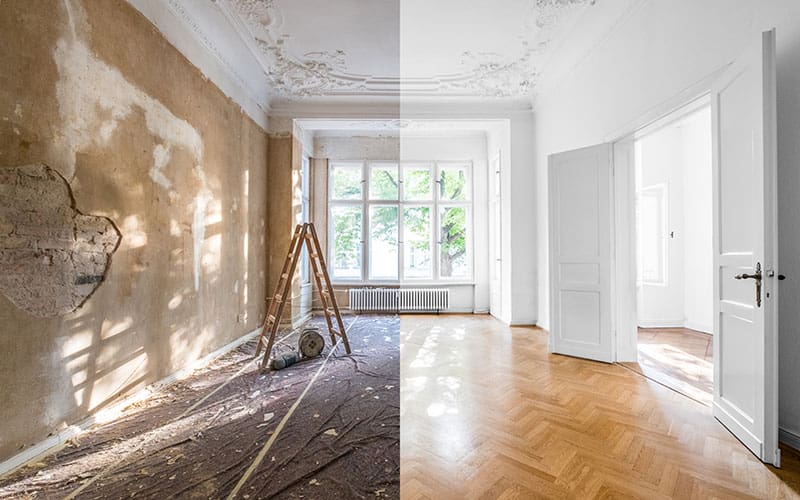
Most homeowners focus on finishes. The real risk sits behind the walls. If you are renovating an old house in North County San Diego, it’s important to look deeper than just the surface.
Renovating a pre-1980 home in North County means dealing with aging systems, evolving code requirements, coastal exposure, and permitting layers that can materially shift scope and cost. The question isn’t “Can we update this?” It’s:
Does this renovation make financial and structural sense, or are we effectively rebuilding?
If you’re early in the planning process, start with a structured home renovation checklist before committing to drawings.
Is Renovating the Right Move?
Not every older home should be renovated.
The decision comes down to three things:
- Location economics
- Structural condition
- Percentage of the house you’re truly keeping
When renovation makes sense
Renovation is rational when:
- Lot value exceeds structure value (common in coastal North County)
- Setbacks or lot constraints limit rebuild potential
- The improved home will remain within neighborhood comps
If your 1960s ranch sits in Leucadia, Del Mar, or coastal Encinitas, the land may justify significant reinvestment. But improvements must align with value ceilings. Overbuilding relative to comps rarely pays back.
If equity growth is part of the objective, ground scope in resale logic, not preference.
When rebuild becomes logical
Rebuild deserves serious consideration when:
- You’re replacing the foundation
- Re-framing exterior walls
- Upgrading full electrical service
- Re-piping the house
- Adding HVAC to a house that never had it
If 60–70% of major systems are being replaced, you are no longer “remodeling.” You’re reconstructing around a compromised shell.
If expansion is part of the discussion, compare strategies before committing:
What’s Behind the Walls?
Pre-1980 homes in North County commonly carry predictable system failures.
These aren’t rare. They’re typical.
Electrical
- 100-amp service (often insufficient today)
- Federal Pacific / Zinsco panels
- Aluminum wiring
- Knob-and-tube in older properties
Upgrading one component often triggers a full-service upgrade.
Plumbing
- Galvanized supply lines (corrode internally)
- Polybutylene failures
- Aging cast iron or clay sewer laterals
Partial repair is rarely strategic. Once walls open, whole-home re-pipe often becomes the rational path.
Structural + moisture
- Foundation settlement
- Undersized framing by current standards
- Dry rot in sill plates and rim joists
- Termite damage in structural members
- Moisture trapped behind older stucco systems
Coastal exposure accelerates deterioration. Salt air, humidity, and deferred flashing upgrades compound issues.
Why this expands budget
One system rarely fails alone.
Replace a panel → triggers service upgrade → may trigger energy compliance.
Open one bathroom → expose the full galvanized system.
Repair framing → requires engineering → alters permit scope.
Missy’s field note
Expert Tip from Missy Barbera, General Contractor
“Older homes don’t go over budget because of finishes. They go over budget because electrical capacity, plumbing condition, and hidden water intrusion show up the moment demolition starts. If you’re renovating pre-1980, budget the investigation phase and protect real contingency. That’s what keeps you from redesigning mid-build.”
Hazardous Materials: Expect It
If the home was built before 1980, assume testing will be required.
Common findings:
- Asbestos (ceilings, flooring, duct wrap)
- Lead paint (pre-1978 homes)
- Mold in moisture-damaged walls
Abatement:
- Happens before demolition
- Extends timeline
- Adds cost
- Is not optional
You can’t demo first and “figure it out later.” Proper sequencing matters.
Radon is generally less common in coastal Southern California homes, but it can be tested easily if a below-grade space exists.
Code Upgrades You May Trigger
This is where scope expands quietly.
Renovation thresholds activate compliance requirements that weren’t part of your initial plan.
Electrical + HVAC
If renovation significantly alters load or square footage:
- 200-amp service often becomes the minimum
- HVAC replacement may trigger energy compliance
- Duct testing, insulation upgrades, and window standards may apply
Plumbing + sewer
Whole-home re-piping is common once galvanized is exposed.
Some jurisdictions require sewer lateral replacement when permit valuation crosses a defined threshold.
Seismic
Altering exterior walls or adding a second story can trigger seismic retrofit requirements:
- Anchor bolts
- Shear walls
- Bracing systems
Title 24 energy compliance
Envelope changes, additions, or mechanical upgrades typically activate energy modeling and performance requirements.
This is why full-gut projects operate differently from light remodels.
Permits and Local Layers
Permits aren’t paperwork. They drive cost and timeline.
Plan check variability
Review timelines depend on:
- Jurisdiction
- Project complexity
- Completeness of submittal
Resubmittal cycles commonly add weeks.
Coastal properties
Homes in the Coastal Zone may require additional review beyond standard building permits. That can add months and design constraints.
Hillside + fire zones
Slope, grading, drainage, and fire hazard zones introduce engineering requirements and ignition-resistant construction standards.
City vs. County
Unincorporated County properties are typically reviewed differently than incorporated cities like Encinitas or Carlsbad.
Planning without understanding your jurisdiction is a common mistake.
Renovate or Rebuild? A Practical Framework
Ask one question:
What percentage of the house are we truly keeping?
If you are retaining only:
- Foundation
- Some exterior framing
…but replacing:
- Electrical
- Plumbing
- HVAC
- Windows
- Roofing
- Insulation
- Interior finishes
You are reconstructing most of the structure.
At that point, compare renovation pricing to new construction pricing honestly.
New construction removes:
- Abatement uncertainty
- Hidden structural discovery
- Integration inefficiency
- Performance compromise
Renovation makes sense when:
- Most structural systems remain intact
- Lot constraints prevent rebuild
- Character preservation has rational value
Can You Stay During Renovation?
It depends entirely on the scope.
You can usually stay if:
- It’s a single-zone remodel
- Utilities remain active
- No hazardous material abatement is occurring
You likely cannot stay if:
- Electrical service is replaced
- Whole-home re-piping occurs
- Structural walls are removed
- Asbestos abatement is required
- More than 50% of the square footage is under construction simultaneously
Occupied construction also extends timelines. Crews work around you.
Blending Old and New Correctly
Modernization should respect architectural logic.
The goal isn’t to erase the home’s era. It’s to improve function without destroying coherence.
Preserve defining features
- Ceiling structure
- Window proportions
- Exterior massing
- Architectural trim language
Match scale and detail
Small mismatches create a “patched together” look:
- Trim height
- Casing profiles
- Cabinet proportions
- Hardware scale
Cabinet decisions often anchor kitchen success.
Improve light + layout carefully
Open floor plans must respect structural logic. Removing non-bearing walls works. Erasing architectural structure often creates visual incoherence.
Learn more about how to renovate an ADU.
Budgeting Realistically
Older home renovation is discovery-driven.
You are not simply executing the scope. You are uncovering it.
Contingency
Pre-1980 major renovations require meaningful contingency. Light remodel math does not apply.
Unknowns are structural, not cosmetic
Expect surprises in:
- Plumbing
- Electrical
- Framing
- Waterproofing
- Prior unpermitted work
Allowances vs. fixed pricing
Itemized allowances allow control. Lump-sum allowances create late surprises.
Procurement discipline
Late material selections cause:
- Delays
- Rush premiums
- Rework
- Change orders
Decision control equals cost control.
Final Thoughts
Renovating an older North County home requires structural clarity before design ambition.
The right move depends on:
- Lot economics
- Structural integrity
- Scope percentage retained
- Code triggers
- Timeline tolerance
- Exit strategy
If the renovation scope overlaps with the majority-replacement territory, the rebuild warrants analysis.
The mistake is assuming renovation is always cheaper. It isn’t, especially once you account for discovery risk, compliance triggers, and integration inefficiencies.
Plan thoroughly. Price honestly. Sequence intelligently.
That’s how older home projects stay controlled instead of reactive.