

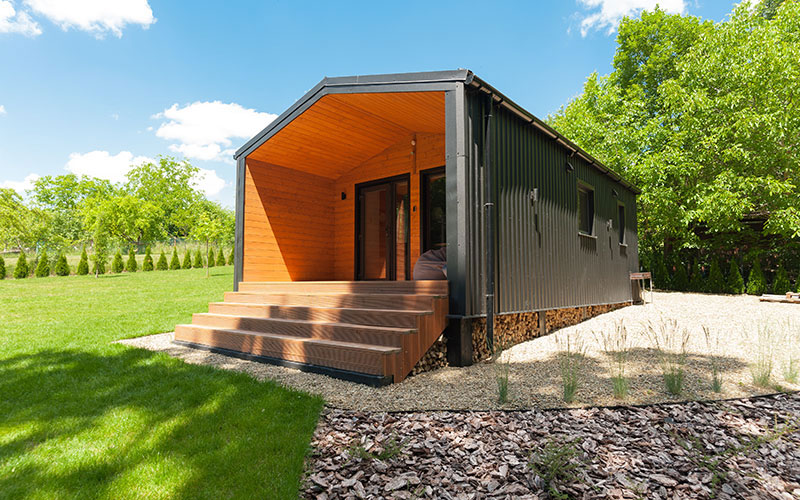
For a custom residential home in coastal North County San Diego, stick-built construction is almost always the right answer. For a detached ADU on the same lot, modular is often the right answer. Most “modular vs. stick-built” articles are written by people who sell one or the other, which is why the comparison rarely produces a clear decision.
The honest version below: definitions, a five-axis comparison, where each method actually wins, and the California-specific factors that shift the math compared to what you read from Midwest or East Coast sources.
What These Terms Actually Mean
Stick-built (also called site-built) is the traditional method. A foundation is poured on the lot and the home is framed and finished in place by trade crews. The structure follows local jurisdiction codes (in California, the California Residential Code plus state amendments and Title 24 energy compliance) and is inspected at each phase by the local building department.
Modular homes are built in three-dimensional sections inside a factory, transported to the lot, and set onto a permanent foundation by a crane. The finished home complies with the same local residential code as a stick-built home. Modular is sometimes called “systems-built” or “prefab.”
Manufactured homes (formerly mobile homes) are a separate category built to federal HUD Code rather than state residential code. They sit on a permanent steel chassis and may or may not be set on a permanent foundation.
Manufactured homes are not equivalent to modular homes and are not what most California buyers comparing “modular vs. stick” actually have in mind. This article treats them as a separate decision.
Learn more: New Construction in North County San Diego
The Five-Axis Comparison
The honest comparison runs across five dimensions. Each has tradeoffs that depend on what you are building and where.
| Dimension | Stick-Built | Modular |
|---|---|---|
| Construction time on-site | 9 to 18 months for a custom home | 1 to 3 weeks set, 3 to 6 months total including factory |
| Customization ceiling | Effectively unlimited within engineering and code | Constrained by module dimensions and factory tooling |
| Construction cost (base spec) | Baseline | 5 to 20 percent less on equivalent spec |
| Construction cost (high custom) | Baseline | Often equal or higher once customizations stack |
| Code compliance | Full state and local code, inspected on-site | Full state and local code, factory third-party inspected |
| Resale in custom-home submarkets | Holds value as comparable to other custom homes | Buyer pool narrower in high-end markets, varies by area |
| Architectural fit to unique lots | Excellent, designed to the site | Limited by module size and crane access |
| Lender comfort | Standard construction loan | Specialized lenders sometimes required |
The cost row is the one that gets misrepresented most often. Modular advantages of 10 to 20 percent are real on a base-spec home where the factory’s standard catalog matches the buyer’s needs. Those advantages compress quickly when the buyer wants higher ceilings, custom rooflines, premium windows, or finishes outside the manufacturer’s standard menu.
In the coastal North County market where buyers routinely specify 10-foot ceilings, premium glazing systems, custom millwork, and architecturally driven floor plans, the construction cost delta between modular and stick-built narrows substantially or disappears entirely.
Where Modular Actually Wins
Modular construction has legitimate advantages and a coastal builder dismissing them is not being honest.
- Schedule certainty. A factory does not lose three weeks to atmospheric river storms or wait two months for an inspector backlog to clear. Factory production schedules are predictable in a way that field construction rarely is. For buyers who need to be in their house by a date certain (school year, lease expiration, relocation), modular schedule certainty has real value.
- Weather-protected assembly. Framing exposed to weeks of rain during a wet winter introduces moisture, warping, and mold risk that takes meticulous drying and inspection to mitigate. Factory assembly avoids this entirely. For sensitive interior conditions or sites with limited dry-storage staging, this matters.
- Repeatability and quality control on standard specifications. Factory tooling and jigs produce consistent results on repeated components. For homes built to the manufacturer’s standard catalog with limited customization, this consistency often beats what a single-crew on-site build produces.
- Better economics on simpler designs. A rectangular two-story home on a flat, accessible lot with a standard plan and standard finishes is the sweet spot for modular. In that scenario, the factory’s advantages compound and the on-site disadvantages stay minimal.
- Strong ADU economics. This is the single largest legitimate modular opportunity in coastal North County, and it gets its own section below.
Learn more: Questions to Ask a General Contractor
Where Stick-Built Actually Wins
Stick-built construction has structural advantages that modular cannot replicate, regardless of how the marketing reads.
Architectural freedom.
A stick-built home can be any shape, any ceiling height, any rooflines, any window configuration, any structural opening. A modular home is constrained by what fits on a truck and what the factory’s tooling supports.
Vaulted great rooms, dramatic indoor-outdoor folding glass walls, complex rooflines, and architecturally driven floor plans are either impossible or expensive add-ons in modular construction.
Fit to unique lots.
Sloped sites, narrow lots, view-driven orientations, tree-preservation grading, and complex setbacks are routine in coastal North County. Stick-built construction handles them. Modular construction either cannot or requires significant on-site modification that undoes the factory’s cost advantage.
Crane and access constraints.
Modular set requires road access for oversize loads, a staging area, and a crane pad. Many coastal North County lots, especially the established Tier 1 neighborhoods in Rancho Santa Fe, Del Mar, and Solana Beach, have narrow private roads, mature trees, and HOA-controlled access that make a modular set logistically difficult.
Single-GC accountability.
On a stick-built home, the general contractor is responsible for the entire envelope. On a modular project, the factory is responsible for what arrives and the GC is responsible for what happens after.
If a window leaks at the module-to-foundation seam or the drywall cracks at a module joint during the first winter, accountability can split. Reputable modular companies have processes for this. The split exists regardless.
Premium and high-custom market fit.
In the upper end of coastal North County (custom homes in the $3M to $20M+ range), the buyer pool expects stick-built. Comparables are stick-built. Appraisals reference stick-built. A modular home in this market has a narrower buyer pool at resale, even when the build quality is equivalent.
Future modification.
A stick-built home is straightforward to add to, modify, or remodel down the road. A modular home has structural elements (module connection points, factory-installed shear walls) that constrain future modifications more than stick-built construction does.
What California Adds to the Comparison
National “modular vs. stick-built” articles, including both top SERP competitors here, are written for markets without California’s regulatory layers. Four California-specific factors change the math in this state.
Seismic engineering.
California sits in Seismic Design Categories D, E, and F across most populated regions. Modular homes designed for non-seismic markets require engineering adjustments for California shipment, and not all manufacturers offer this. Verify before signing that the manufacturer routinely builds to California seismic standards and that the structural engineer of record is licensed in California.
Title 24 energy compliance.
Every new home in California must comply with Title 24 Part 6 energy standards, which include envelope performance, mechanical systems, lighting, and renewables.
Modular manufacturers that ship into California are familiar with this, but Title 24 compliance is one of the highest-friction zones in any new-home project. Confirm that the manufacturer’s Title 24 documentation is complete and current for California’s most recent code cycle (current standards updated triennially).
Coastal Development Permit jurisdiction.
Within the California Coastal Zone (including most of Encinitas, Carlsbad, Solana Beach, Del Mar, and coastal-facing parts of unincorporated areas), a Coastal Development Permit may be required.
The CDP process applies equally to modular and stick-built construction, but modular projects can hit additional friction when the home’s appearance or massing requires review and the manufacturer’s standard plans don’t match what the Coastal Commission or local jurisdiction will approve.
Wildfire WUI requirements.
Inland sections of coastal North County (including parts of Rancho Santa Fe and the eastern reach of Encinitas) sit within the Wildland-Urban Interface. WUI homes require Class A roof assemblies, ember-resistant vents, ignition-resistant siding, and other specifications. Some modular manufacturers offer WUI-compliant builds, but this needs to be confirmed up front, not assumed.
A reasonable rule for California specifically: if the modular manufacturer cannot demonstrate active California project experience, current Title 24 compliance, California seismic engineering, and WUI capability where applicable, the cost and time advantages on paper will likely be eroded by on-site rework.
The ADU Exception
Accessory Dwelling Units are the scenario where modular construction makes the most sense in coastal California, and it is worth treating as a separate decision from the primary residence.
California state law (SB 9, SB 13, AB 68, AB 881, and subsequent amendments) has substantially liberalized ADU permitting. Most coastal North County jurisdictions now allow ADUs up to 1,200 square feet by-right on most lots, with streamlined permit review and waived setback constraints. This regulatory framework matches modular construction’s strengths: a defined size envelope, repeatable design, and a process where speed and predictability outweigh customization.
A modular ADU in coastal North County typically lands between $175,000 and $350,000 turnkey for a 600 to 1,200 square foot unit, depending on finish level, foundation type, site work, and utility connections.
An equivalent stick-built ADU usually runs $300,000 to $600,000 in the same market. The cost delta is real and the schedule advantage is meaningful: a modular ADU can be permitted, factory-built, and set in three to six months total compared to nine to fifteen months for a stick-built ADU.
The tradeoffs are real but smaller than on a primary residence. A 1,200 square foot ADU has limited room for elaborate architecture in either method. Module size constraints rarely bind. Crane access to the rear of a lot for a modular set is sometimes a real constraint and sometimes solvable with a longer-reach crane or a yard-access plan worked out in advance.
For coastal North County homeowners adding an ADU for rental income, multi-generational use, or property value, modular deserves serious consideration. For coastal North County homeowners building a primary residence at custom-home spec, modular rarely makes financial or design sense.
Decision Framework
The decision usually comes down to four questions.
- How much architectural customization do you want? If the answer is “the manufacturer’s catalog is fine with minor changes,” modular is a reasonable path. If the answer is “I want a unique design from an architect,” stick-built is almost always the right answer.
- How constrained is your site? Flat, accessible, with truck and crane staging room: modular works. Sloped, narrow, view-driven, tree-preserved, or in a tight Tier 1 neighborhood: stick-built almost always works better.
- What is the project scale? Primary custom residence on a Tier 1 coastal lot: stick-built. Detached ADU on the same lot: modular often wins.
- What market are you selling into eventually? In the high-end custom-home submarket, stick-built holds value because that is what comparables and buyers expect. In a standard new-home market where the home will compete on price and features rather than on architectural distinctiveness, modular’s discount can transfer to resale or it can hurt, depending on the local buyer pool.
FAQs
Is a modular home worse quality than a stick-built home?
Not inherently. A well-built modular home meets the same residential codes and can be built to comparable structural standards as a well-built stick-built home. The variance within each category (good builder vs. mediocre builder) is wider than the variance between categories. Quality depends on the manufacturer, the GC handling site work and assembly, and the inspector chain.
Can I tell the difference between a modular and a stick-built home once it is finished?
Visually, usually no. A skilled modular set with proper finish work produces a home that is indistinguishable from stick-built on the surface. Inspection of structural details, module connection points, and the foundation-to-module transition can reveal which method was used.
Will a modular home appraise lower than a stick-built home in California?
In standard-spec markets, no. In high-end custom-home markets, sometimes. Appraisers in coastal North County typically compare a home to other custom stick-built homes in the area, and a modular comparable may pull the appraisal toward a different cohort. This is more of an issue in the upper end of the market than in the median.
How long does a modular home take to build in California compared to stick-built?
Total project timeline (design through move-in) is typically three to six months for a modular ADU and four to seven months for a modular primary residence, against nine to fifteen months for a stick-built ADU and twelve to eighteen months for a stick-built primary residence. California permitting can add to either timeline.
Are modular homes harder to finance than stick-built homes?
They can be. Conventional construction loans handle both, but some lenders treat modular financing as a specialty product with fewer institutions participating. Confirm financing before signing with a modular manufacturer.
What about hybrid builds, primary stick-built with a modular ADU?
This is a sensible pattern for many coastal North County properties. The primary residence is built to custom architectural specifications using stick-built construction. The ADU, with its standardized size envelope and rental or family-use purpose, is built modular for cost and speed advantages. A single GC can coordinate both, sequencing the modular ADU set to minimize disruption to the primary build.
Does an HOA Art Jury or design review board affect a modular home decision?
Yes. The Rancho Santa Fe Covenant Art Jury and similar review boards in other coastal North County HOAs evaluate exterior design, materials, and massing. Modular plans need to be submitted and approved in the same way as stick-built plans. The constraint is that modifying a modular design to satisfy Art Jury feedback may be more expensive than modifying a stick-built design, since the factory’s tooling and standard plans push back on changes.
Is a manufactured home (HUD code) the same as a modular home?
No. Manufactured homes are built to federal HUD Code on a permanent steel chassis and are a different category for zoning, financing, appraisal, and resale purposes. Many coastal North County jurisdictions restrict where manufactured homes may be placed. Modular homes built to state residential code are treated equivalently to stick-built homes for zoning and code purposes.