

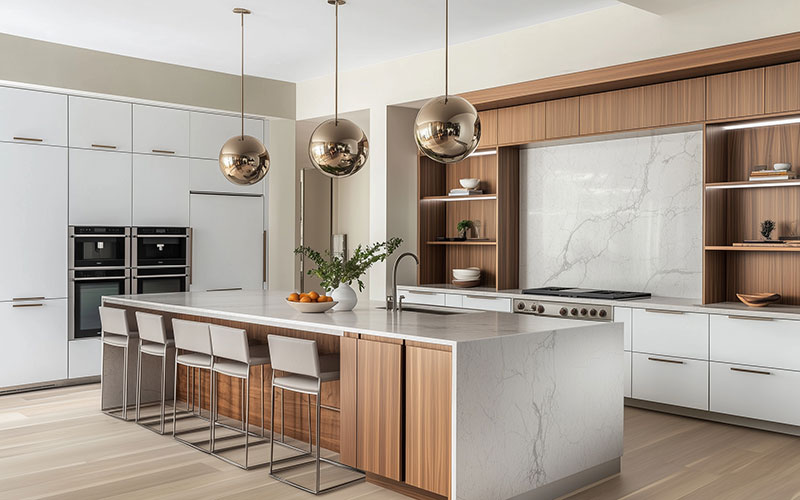
Most kitchen remodels in North County land somewhere between $60,000 and $180,000. Where you fall on that range comes down to three things: scope (cosmetic refresh vs. structural change), the age of your home, and finish level. Two kitchens with identical cabinets and countertops can finish $50,000 apart once you account for what’s hidden behind the walls.
This guide covers what you’ll spend at each tier, where the money goes, and how to budget for the surprises older homes always seem to have.
What you’ll spend at each tier
Cosmetic refresh: $60,000–$90,000
Cabinets and countertops in their current locations, new appliances, updated lighting, refinished or new flooring. No layout changes, no plumbing relocations, no panel work. The shortest path to a meaningful update.
Mid-range remodel: $100,000–$160,000
Layout changes within the existing footprint, plumbing relocations, gas line upsizing for a professional range, cabinet upgrades to semi-custom or custom, and finish materials in the quartzite or marble range. This is where most North County kitchen projects land.
Structural remodel: $180,000+
Removing load-bearing walls, opening the kitchen to adjacent living spaces, slab plumbing relocations, electrical panel upgrades, custom inset cabinetry, and coordination with whole-home work. Older homes and coastal lots regularly push past $250,000 once concealed conditions surface.
Where the money goes
A typical full kitchen remodel breaks down roughly like this:
| Category | Share of budget |
|---|---|
| Cabinetry | 25–35% |
| Countertops | 8–12% |
| Appliances | 10–15% |
| Labor (demo, framing, finish) | 20–25% |
| Plumbing, electrical, HVAC | 10–15% |
| Tile, flooring, paint | 8–12% |
| Permits, design, contingency | 5–10% |
Cabinets and labor are the two big movers. Custom inset cabinetry runs 40 to 60 percent above frameless semi-custom for the same configuration. Labor scales with how much demolition, framing, and trade coordination your scope demands.
What actually drives cost variance
Two homes with the same scope on paper can finish $40,000 to $80,000 apart. The variance comes from the parts of the job you can’t see until demolition starts.
- Structural work. Removing a load-bearing wall requires an engineered beam. A 10-foot beam runs $3,500 to $6,000 installed. A 20-foot steel beam with foundation reinforcement can exceed $15,000.
- Service capacity. Upgrading from a 100-amp to 200-amp electrical panel runs $3,000 to $5,500. A professional range typically needs 1-inch gas supply instead of the existing ½-inch, adding $2,000 to $4,500 if new piping has to be routed through finished spaces.
- Slab plumbing. Relocating drains for an island sink in a slab home means concrete cutting, trenching, and patching: $4,000 to $7,000 for a clean run. Post-tension slabs, common in homes built from the 1970s onward, require GPR scanning at $800 to $1,500 before any cuts.
- Make-up air. Range hoods above 400 CFM trigger make-up air requirements in most jurisdictions. Solutions range from $800 passive vents to $7,000 ducted systems with integrated controls.
- Subfloor and venting. Older homes regularly need subfloor replacement around former dishwasher leaks, knob-and-tube remediation before a panel can be upgraded, or hood ductwork rerouting because the existing path won’t handle a higher-CFM unit.
- These aren’t optional upgrades. They’re code-driven costs that surface during inspection, and they’re the reason a flat percentage contingency doesn’t work for older homes.
Setting contingency by risk class
| Risk class | Home profile | Contingency |
|---|---|---|
| Low | Post-2000 construction, prior work professionally executed | 10–15% |
| Medium | 1980–2000 construction, or newer with system relocations | 15–20% |
| High | Pre-1980, slab with post-tension constraints, visible DIY work | 20–25%+ |
Contingency covers concealed conditions and code-required upgrades discovered during inspection. It does not cover scope additions or finish upgrades. Track every change order against the reserve so you know what’s left when something legitimate surfaces in week six.
How long it takes
Cosmetic refreshes run 6 to 8 weeks from permit approval to final inspection. Mid-range remodels with layout changes and service modifications take 10 to 14 weeks. Structural remodels coordinated with whole-home work run 16 weeks or longer. Add 2 to 4 weeks for permit review before construction starts. Material lead times on custom cabinetry and specialty stone can extend the schedule another 4 to 8 weeks if orders aren’t placed early.
If you stay in the home during construction, plan for an additional 20 to 30 percent on the timeline. Limited work hours and access constraints slow trades down.
Learn more: How Long Does a Kitchen Remodel Take?
What you’ll get back at resale
National data puts mid-range kitchen remodel ROI in the 50 to 75 percent range, with execution quality and how recently the work was done driving most of the variance. In competitive markets, a current, well-executed kitchen helps a home sell faster and reduces buyer concession requests, even when the dollar-for-dollar return looks moderate.
The remodel pays back better when you stay in the home long enough to use it. A $120,000 kitchen amortized over ten years of daily use is a different calculation than the same kitchen completed six months before listing.
How to control your budget
Lock the layout before permitting. Layout changes after framing inspection require re-engineering, amended permits, and rework that runs 150 to 200 percent of the original cost.
Finalize selections before rough-in. Cabinet drawings, appliance specs, and tile elevations should be approved before the plumber and electrician set rough-ins. Late selections force trades to work out of sequence.
Set written allowances. Tile at $X per square foot, countertops at $Y, fixtures at $Z. Track burn against each line so a quartzite upgrade doesn’t quietly absorb your lighting budget.
Require written change orders. No verbal site-walk agreements. Every scope change gets priced, scheduled, and approved in writing before work proceeds.
Investigate before demolition. GPR scanning on slabs, panel capacity verification, and water-damage inspection around existing fixtures cost less than the change orders they prevent.
Learn more: Small Kitchen Remodel Ideas
Frequently asked questions
What’s the average cost of a kitchen remodel?
Cosmetic refreshes typically run $60,000 to $90,000, mid-range remodels $100,000 to $160,000, and structural remodels $180,000 and up. Older homes and coastal lots cost more due to concealed conditions and code-required upgrades.
How long does a kitchen remodel take?
Six to eight weeks for cosmetic work, 10 to 14 weeks for mid-range, 16 weeks or longer for structural. Add 2 to 4 weeks for permit review and 4 to 8 weeks for custom cabinet and stone lead times if ordered late.
How much should I budget for contingency?
10 to 15 percent for low-risk projects in newer homes, 15 to 20 percent for medium-risk projects with layout changes, 20 to 25 percent or more for high-risk remodels in older homes or those with structural scope. Contingency covers concealed conditions, not scope additions.
What’s the typical ROI on a kitchen remodel?
50 to 75 percent at resale for mid-range remodels, with execution quality and how recently the work was done driving most of the variance. Real return depends heavily on how long you stay in the home.
Can I live in my home during a kitchen remodel?
Possible for cosmetic and many mid-range projects if you can isolate the work zone with dust barriers and maintain a functional bathroom and sleeping area. Move out for structural scope, multi-day utility shutdowns, or whole-home coordination.
What’s the most common reason kitchen remodels go over budget?
Concealed conditions in older homes (slab constraints, outdated wiring, undersized service capacity) discovered after demolition, plus late design decisions that force rework after rough inspection. Both are addressable with preconstruction investigation and a locked decision calendar.
Learn more: How to Increase Home Value Through Major Renovation