

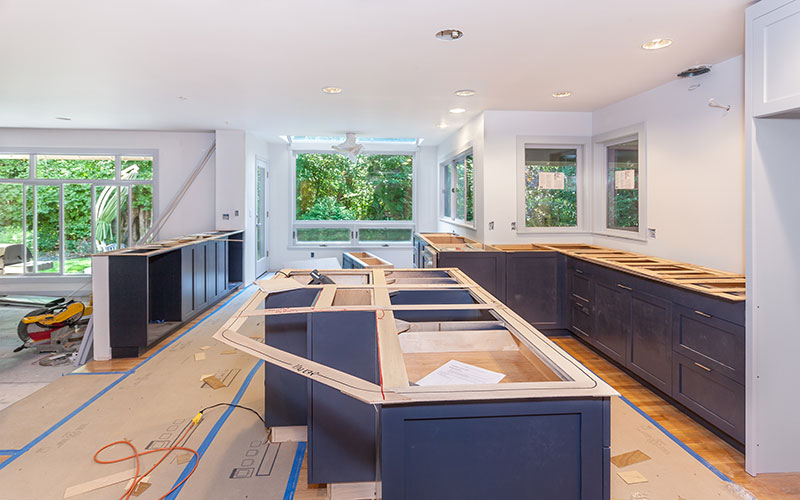
Most homeowners start with the wrong question: “Which upgrades have the best ROI?” If you want to learn how to increase home value through renovation, before ROI, you need to understand execution. Permitting gates, inspection holds, procurement deadlines, and budget mechanics determine whether a remodel protects equity or consumes it.
Generic ROI lists miss three realities. Value is locally driven by neighborhood price ceilings and buyer expectations, not national averages. Overruns come from soft costs, allowances, and change orders that surface after construction starts. And major remodels follow a gated sequence: if selections and approvals miss their milestones, the schedule stalls.
This guide lays out a practical framework for North County San Diego homeowners planning $150K+ whole-home or multi-room work. You’ll learn how to prioritize improvements based on buyer objections (not feature lists), how to build a budget that includes the cost drivers most people omit, and how permitting, inspections, and procurement shape timeline risk. If you want the sequencing view first, start with a step-by-step home renovation checklist that matches how real projects run.
Missy’s Field Note
Expert Tip from Missy Barbera, General Contractor
“Before you finalize your remodel budget, call two local listing agents and ask a simple question: “What inspection credits are buyers most commonly requesting right now in this zip code?”
In North County, those answers shift with market cycles. One year it’s aging roofs and sewer laterals. Another year, it’s undersized panels or HVAC systems that can’t keep up with heat waves. If buyers are consistently negotiating the same repair credits, that tells you exactly where value protection lives.
I’ve seen homeowners invest heavily in visible upgrades while leaving the very items buyers later demand concessions for. The result isn’t a lower resale price; it’s reduced leverage. Fix what buyers are currently using to negotiate, and you protect equity before you try to increase it.”
When a Major Remodel Makes Sense for Resale Value
Remodeling before a sale only pencils out when three factors align: the work removes buyer objections (not just adds features), comps support your target price, and your timeline fits market conditions.
In practice, you’re deciding whether the improvement spend is supported by the neighborhood and whether you can carry a 6-18 month execution window without getting trapped by shifting rates, inventory, or permitting delays.
Buyer objections vs. feature upgrades
Returns are driven more by removing deal-breakers than adding luxury. A non-functional kitchen, one bathroom in a three-bedroom home, or visible deferred maintenance narrows your buyer pool and forces discounts. Those are objection conditions that cause buyers to walk or anchor low.
Features are different. High-end appliance packages, custom-built-ins, or boutique finishes can be desirable, but they rarely recoup costs if they exceed local norms. In coastal North County markets (Encinitas, Del Mar, Rancho Santa Fe), buyers expect functional kitchens and baths, code-compliant systems, and a solid envelope. In that context, “outdated” often functions as an objection because the competing inventory sets the baseline.
Neighborhood price ceiling and comp analysis
Every neighborhood has a ceiling set by recent closed sales. If comps for similar square footage, lot, and location cluster at $1.2M-$1.4M, a remodel plan that assumes a $1.7M exit price is a warning sign. Buyers shopping in that area are pre-qualified for the prevailing range; pricing above it means competing with other neighborhoods with different fundamentals.
Pull closed sales from the last six months within roughly a half-mile, filter for similar size and condition, and find the top-quartile sale prices. That band is your realistic ceiling. If your planned scope pushes you meaningfully above it, the excess spend tends to return poorly at sale.
Timeline to sale and market cycle considerations
A major remodel adds time before you can sell: design, plan review, procurement, construction, inspections, and closeout. If today’s market favors sellers, selling as-is can outperform waiting through a remodel cycle while conditions change. Remodeling makes more sense when you can hold through the timeline (often because you’re staying three years post-completion) or when functional obsolescence limits what the home can achieve as-is.
Once you’ve confirmed timing and that comps support the idea, the next step is to choose the right improvements using a framework that mirrors how buyers behave.
Learn More: Home Remodeling Services
A Three-Lens Value Framework: Prioritizing Improvements
Instead of chasing generic ROI percentages, evaluate scope through three lenses, in order:
- Marketability: does it remove deal-breakers?
- Function: does it fix layout/system constraints buyers will negotiate?
- Strategic upgrades: do comps prove buyers pay for it here?
This matters because the same upgrade can be “worth it” in one pocket of North County and wasted in another.
Lens 1: Marketability (eliminate deal-breakers)
Deal-breakers reduce your buyer pool and trigger discounts. Think: visibly failing systems, clear code issues, water intrusion, obvious maintenance deferral, or a layout that forces buyers into immediate remediation. In coastal submarkets, a tired kitchen and failing envelope often aren’t neutral; they’re objections because the competing inventory makes “updated” the baseline.
Handle these first. They don’t “add” value so much as prevent value loss at negotiation.
Lens 2: Functional fixes (layout, systems, code compliance)
Function doesn’t always show up in photographs, but it drives inspection outcomes and negotiation leverage. Poor flow, inadequate storage, undersized panels, weak HVAC capacity, and compromised plumbing limit the home’s livability and constrain future improvements. Buyers may not articulate these on a first walk-through, but they surface in inspection responses and credit requests.
Address the constraints that create recurring buyer friction before you invest in finish upgrades.
Lens 3: Strategic upgrades (where comps support investment)
Strategic upgrades are features beyond baseline. Outdoor living can command premiums in coastal areas if comps show buyers are willing to pay for it. Primary suite work can be valuable if your comp set rewards it. Custom “nice-to-haves” can be real value in some neighborhoods and dead money in others.
Score each upgrade by: buyer impact (how many buyers value it), cost relative to the neighborhood ceiling, and disruption to schedule/permit pathway. Only keep the upgrades that clear all three.
Before you lock scope, you need to reduce hidden-condition risk because surprises are where ROI gets destroyed.
Preconstruction Investigations: Reducing Hidden-Condition Risk
Pre-demo investigations don’t eliminate risk, but they convert unknowns into knowns early when you still have options. Skipping this step is how hidden conditions become mid-project change orders that inflate cost and extend the schedule.
If you’re planning a broader whole-home remodel scope, the investigation phase is what protects you from designing a project that can’t be executed within the budget you think you have.
Structural and foundation assessment
Structural evaluation flags issues that affect scope and approvals, including foundation movement, envelope failures, load path constraints, and seismic deficiencies triggered by your permit scope. In older housing stock, once you open walls and submit for plan review, code-driven requirements can expand. Documenting existing conditions and likely triggers up front reduces midstream redesign.
Electrical panel capacity and code compliance
Service capacity determines whether your house can support modern loads. Many older homes in the area weren’t built for today’s appliance + HVAC demands. Once walls open and the scope includes electrical, code requirements may require upgrades to the project. An early electrical assessment clarifies whether you’re dealing with minor circuit work or a service upgrade with utility coordination and its own permitting/inspection sequence.
Plumbing, routing and fixture compatibility
Plumbing feasibility is often about routing access. Relocating fixtures can be simple with crawl-space access, but more expensive with slab constraints. Older materials and venting configurations can also trigger a “must-fix” scope once the permit is triggered. Map the routing, confirm constraints, and validate that the planned layout is buildable without unexpected demolition.
Hazardous materials and HVAC checks
Age of the home matters. Where warranted, testing for asbestos and lead avoids dangerous and legally fraught surprises mid-demo. HVAC evaluation prevents a common failure mode: finishing the remodel only to discover the system can’t condition the new layout, or the ducting can’t be routed as designed.
Once conditions are understood, build a budget model that reflects real costs.
Budget Model for Major Remodels
Most budgets fail because they only price the visible work. A realistic budget separates cost categories by risk profile: hard costs, soft costs, allowances, contingency, and change orders. If you want to protect ROI, you need control points for each one.
Hard costs vs. soft costs
Hard costs are the physical work: demo, framing, MEP, drywall, finishes, cabinetry, and installed fixtures. Soft costs are what enable the job: architecture/engineering, energy compliance, permits/plan check, third-party requirements, and management overhead. In major work, soft costs aren’t a rounding error. Budgeting without them makes “ROI math” a fantasy.
Allowances and how they work
Allowances are placeholders, not caps. If allowances are low, the budget is low, but the final cost will rise once selections are made. Track allowance items separately and treat selection decisions as budget decisions.
Contingency planning and change-order mechanics
Contingency is for unknown conditions, not “nice upgrades.” Change orders are how scope shifts get documented, priced, and scheduled. If you don’t insist on written change orders that include schedule impact, you’ll lose control because cost increases and timeline slips will show up as “just how it goes.”
Permits and inspections then become the backbone of the schedule. Ignore them, and your timeline becomes wishful.
Permit Pathway Overview: What Triggers Plan Review
Permits divide projects into those that require formal plan review and those that don’t. Structural work triggers plan review everywhere. Major system work triggers permits and inspections even without structural changes. Cosmetic work can sometimes proceed without permits, but once your scope touches regulated systems, you’re in a gated sequence: submit, corrections, resubmit, approval, build, inspections, closeout.
North County processes vary by jurisdiction. Coastal overlays can add review layers. The practical takeaway is simple: your permit pathway is a timeline dependency, not paperwork.
Inspection Gates and Construction Sequencing
Inspections are gates. Work stops until a phase is approved. That makes the inspection calendar part of your critical path, not an afterthought.
Demo and pre-construction checks
Where needed, hazardous material testing and abatement precede demo. Site protection and safety controls are established before work begins. Some projects require documentation of existing conditions, especially when structural work is involved.
Rough framing, MEP, and insulation gates
Framing inspection precedes MEP rough-in approvals. Rough electrical, plumbing, and mechanical inspections precede insulation. Insulation and energy compliance checks precede drywall. Failures mean corrections and re-inspection, often a schedule hit. This is why experienced teams build inspection readiness into daily QC rather than waiting for the inspector to catch it.
Final inspections and closeout
Final approvals verify life-safety and system function. Expect at least one correction cycle at closeout. If your schedule has no buffer, a minor final can become a major delay.
Procurement is the other major timeline driver because you can’t install what you don’t have.
Selections and Procurement Calendar
Procurement runs backward from install dates. Miss a deadline, and you either stall the job, substitute products, or pay expedite fees. Long-lead items should be identified early and ordered against the construction calendar.
Windows, doors, and structural components
Openings must match actual units. Structural components must align with approved plans and calculations. Late substitutions can trigger revision cycles and inspection risk.
Cabinets, countertops, and tile
Cabinets drive rough-in locations and downstream sequencing. Countertops can’t be templated until cabinets are installed. Tile impacts waterproofing and transitions. Late selections create rework or downtime, both of which destroy value.
Plumbing fixtures, lighting, and appliances
Fixtures define rough-in dimensions. Lighting defines box placement and compatibility. Appliances define electrical and venting requirements. Delivery can be later; specifications cannot.
That leaves logistics, as occupancy decisions affect both safety and schedule.
Living Logistics and Site Protection Planning
If you’re staying in the home, your plan has to match reality: dust, noise, access constraints, and safety zones. Phased work can keep basics functional but usually increases duration. Move-out can compress the schedule but adds rental and logistics costs.
Phasing strategies (stay vs. move out)
Staying requires one functional bathroom, a workable temporary kitchen, and a safe egress plan. If the scope disrupts the entire home’s electrical/plumbing, or involves hazardous abatement, move-out is often the practical choice.
Temporary kitchen and bathroom arrangements
Temporary kitchens are about survivability, not comfort. Bathrooms are the hard constraint. If you can’t maintain daily hygiene access, living-in becomes operationally unsustainable.
Dust, noise, and pet/child safety planning
Barriers and filtration reduce dust, not eliminate it. Noise is intense during the demo and framing. Children and pets require hard separation from the site, not “we’ll watch them.”
With all that, ROI is evaluated based on comps and timing, not percentages.
ROI Reality Check: Comps, Timing, and Market Conditions
ROI is local. Use recent closed comps to set your ceiling and define “supported spend.” The market’s top-quartile sales are the boundary conditions for your plan. Timing matters because the longer the hold, the more “new improvements” become “current condition,” and the more the market can shift under you.
Published recoup rates are directional at best. Your scope should be anchored to your specific comp set and your actual execution window.
Final Thoughts
Major renovations increase value when they remove buyer objections, fit within neighborhood pricing, and are executed with discipline. Preconstruction investigation, realistic budgeting (including soft costs and contingency), and tight control of permit/inspection and procurement gates are what keep ROI from evaporating.
If you want to explore how this applies to your home or a specific North County submarket, the best place to start is getting the process right, then deciding whether the scope is worth it.
Planning Your Project with Skyhorse Construction
A major remodel is less about “managing trades” and more about preventing scope gaps, schedule stalls, and budget drift.
Teams that understand local permitting, inspection sequencing, and coastal constraints reduce the avoidable failure modes. If you want to see how Skyhorse approaches these projects across North County, learn more about our general contracting approach in Encinitas.
Frequently Asked Questions
How much should I budget for soft costs on a major remodel?
Soft costs typically account for 15-25% of hard construction costs. That includes architecture/engineering, energy compliance, permits/plan check, required third-party items, and management overhead. Complex scopes and coastal constraints push that higher. Budgeting without soft costs is one of the fastest ways a “value-add remodel” becomes a cash drain.
What’s the typical timeline for a whole-home remodel in North County?
Expect roughly six to eighteen months from design start to completion, depending on scope and jurisdiction. Design + permit review can take weeks to months, and construction can run several months to a year. Coastal overlays, structural engineering, and inspection correction cycles add time. Plan with buffers at each inspection gate.
Should I stay in my home during construction or move out?
Move-out often compresses the schedule but adds rental and logistics costs. Staying requires phasing, which typically extends duration and increases daily disruption. Whole-home system work, structural reconfiguration across occupied areas, and hazardous material abatement frequently make move-out the safer and more practical option.
How do I know if my planned improvements will exceed neighborhood pricing?
Pull recent closed sales within a defined radius, filter for similar size and condition, and identify the top-quartile sale prices. That’s your realistic ceiling. If your target price is meaningfully above it, you’re competing with different neighborhoods and asking buyers to pay a premium that the area doesn’t support.
What happens if inspections fail during construction?
Work stops until corrections are made and re-inspection is approved. Minor issues can still cost meaningful time depending on the inspector’s availability. Building schedule buffers and ensuring inspection-readiness QC before the inspector arrives is cheaper than rework afterward.
When do I need to finalize material selections?
Long-lead items require early finalization: windows/doors, cabinetry, and many fixtures. Plumbing fixtures and appliances must be specified before the rough-in, as they determine dimensions and electrical/venting requirements. Tile needs to be locked before waterproofing and substrate work. Late decisions either stall the job or force expensive substitutions.
Do I need permits for kitchen and bathroom remodels?
It depends on the scope. Structural changes and major system work require permits. Purely cosmetic work may not, but once you trigger permit review, code compliance requirements can expand. Requirements vary by jurisdiction in North County, so confirm early in feasibility before design is finalized.
How much contingency should I budget for unforeseen conditions?
Budget 10-20% depending on age and scope. Older homes and structural work increase the risk of discovery. Contingency is for hidden conditions, not elective upgrades. Without it, surprises force rushed value engineering that compromises the outcome.