

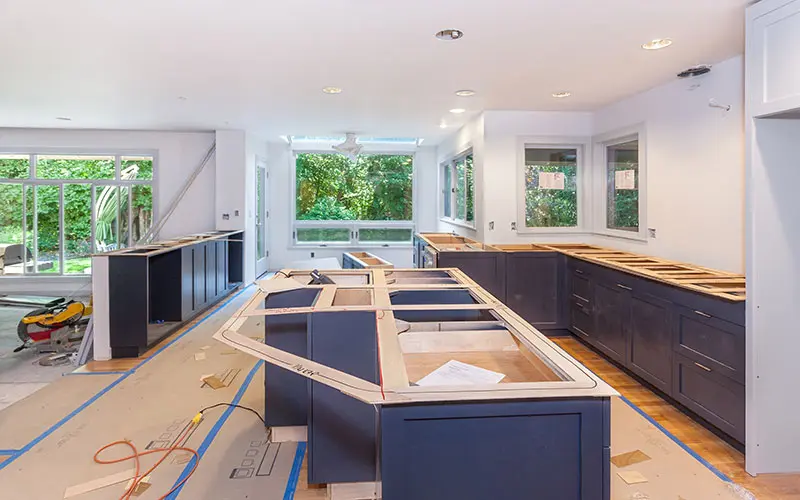
Clients planning a kitchen remodel in one of these three cities usually want to know which one is slowest, on the assumption that the answer is a fixed property of the city. It is not. For a genuinely interior kitchen remodel, all three cities move at roughly the same pace, because all three treat interior work as the least burdensome category they have.
What separates them is what happens the moment your scope touches the outside of the building. That single line determines your calendar, and the penalty for crossing it is wildly different depending on which side of Via de la Valle you live on. In Encinitas you stay inside a local process. In Del Mar you enter a noticed review with an appeal window attached. In Solana Beach you leave city jurisdiction altogether.
The line that actually sets your timeline
Every one of these jurisdictions distinguishes between ministerial work, which a plan checker approves against the code, and discretionary work, which a board or a commission approves against a judgment about appearance, neighborhood character, or coastal resources. Ministerial review has a queue. Discretionary review has a calendar, a public notice period, and an appeal window, and none of those compress no matter how well prepared your set is.
A kitchen that stays inside the existing envelope is ministerial almost everywhere. Cabinetry, counters, flooring, appliances, interior electrical and plumbing, and even wall removal fall on the ministerial side as long as nothing changes outside. Cross the envelope and the project changes category, and category is what costs you months.
Encinitas
Encinitas is the most straightforward of the three, largely because it has taken the discretionary question off the table for interior work explicitly. The city’s design review chapter lists interior remodeling work on any existing building as exempt, which means a kitchen that stays inside the walls never reaches a design review permit at all.
Submittals run through the city’s Customer Self Service portal, and the city is fully paperless. Registration in the portal is required before you can submit anything and is approved within twenty-four business hours, which is a small detail that catches first-time applicants who assume they can register and submit the same afternoon. Plan check itself is performed under contract by a third-party firm rather than by in-house city staff, a structure worth knowing because it shapes how corrections come back and who you are actually talking to when you have a question.
One Encinitas-specific rejection cause deserves attention. The applicant states an estimated permit valuation at application, and the building official has explicit authority to deny a permit where that valuation appears understated, unless the applicant produces detailed estimates that satisfy them. Undervaluing a high-end kitchen to reduce fees is a strategy that stalls the permit rather than saving money, and it is an avoidable round of correspondence.
Del Mar
Del Mar has the most structured design review process of the three and, counterintuitively, that structure works in your favor on an interior kitchen because the tiers are clearly drawn.
The city sorts projects into three buckets. Exempt work proceeds without design review. Minor but non-exempt work goes to Administrative Design Review, where the Director of Planning and Community Development decides rather than a board, subject to a ten-day notice period. Should a neighbor file a timely objection during that window, the project moves onto the next available Design Review Board agenda for a public hearing. Everything neither minor nor exempt goes to the full DRB at a noticed public hearing from the start.
An interior kitchen sits in the exempt bucket. Del Mar’s contract building department, EsGil Corporation, issues authorizations for interior remodeling directly alongside other minor permits. Worth knowing before you drive anywhere: that building counter is not in Del Mar. It operates out of Solana Beach City Hall on South Highway 101, an arrangement that surprises nearly every homeowner who encounters it for the first time.
The reason to understand Del Mar’s tiers even when your project is exempt is what happens if the scope grows. Adding a skylight, enlarging a window, or modifying a roofline to accommodate a hood vent can pull a kitchen into ADR, and an objection from one neighbor during the ten-day notice converts an administrative decision into a public hearing. Decisions of the DRB may then be appealed to the City Council within ten working days. Each of those steps is reasonable individually. Stacked, they are the difference between a permit in weeks and a permit in seasons.
Solana Beach
Solana Beach is where the structural difference between these cities becomes stark, and it comes down to one fact that most homeowners do not know until they are in it.
The entire jurisdiction of Solana Beach lies within the California Coastal Zone. Every development application in the city must be reviewed and approved by the California Coastal Commission, and the city does not process those approvals internally. Coastal Development Permits, waivers, and exemptions are handled by the Commission rather than by city staff, and it is the applicant’s responsibility to deliver the CCC approval letter to the city before a building permit issues.
Read that carefully, because the implication is easy to miss. In Encinitas and Del Mar, the coastal question is resolved by a local agency operating under a certified Local Coastal Program, which means one relationship and one queue. In Solana Beach, any project that requires coastal review sits in a queue the city does not manage and cannot expedite. Your general contractor’s relationship with city staff is worth exactly nothing to that timeline.
Interior kitchens generally avoid this, and the city’s guidance is to submit the application so staff can confirm whether Commission approval will be required for your specific scope. On the planning side, each submittal and resubmittal runs a thirty-day review period, so every round of corrections has a defined and non-negotiable floor. Permits move through the eTrakit portal. One additional trap for kitchen projects: construction over sixteen feet in height triggers a Structure Development Permit, which is relevant if new mechanical equipment ends up on the roof rather than at grade.
The three cities side by side
| Factor | Encinitas | Del Mar | Solana Beach |
|---|---|---|---|
| Interior kitchen, no exterior change | Exempt from design review by ordinance | Exempt tier; permit issued as minor building permit | Building permit; confirm with staff whether CCC review applies |
| Who resolves coastal review | City, under certified Local Coastal Program | City, under certified Local Coastal Program | California Coastal Commission, not the city |
| Discretionary path if scope grows | Design review permit | Administrative Design Review, escalating to DRB on objection | Planning review at 30 days per round, plus Commission |
| Who performs plan check | Third-party firm under contract | EsGil Corporation, counter at Solana Beach City Hall | Contract building services through Community Development |
| Submittal method | Customer Self Service portal, fully paperless | Planning authorization, then building counter | eTrakit portal and electronic submittal |
| Built-in waiting periods | 24 business hours for portal registration | 10-day ADR notice; 10 working days to appeal a DRB decision | 30-day review per submittal and resubmittal |
Note what the table does not contain. There is no column for how long each city takes, because for interior work the honest answer is that the three are close enough that the difference will not decide your project. The rows that matter are the second and the last, and both of them only activate when scope crosses the envelope.
What pushes a kitchen across the line
Almost nobody sets out to trigger discretionary review. It happens through accumulation, and the items that do it are unremarkable on their own. Enlarging or relocating a window to bring light to a new sink location. Adding a skylight over an island. Cutting a new exterior penetration for a hood vent, particularly where it means a roof modification. Widening a door to the patio because the new layout reorients toward the outdoor space. Relocating mechanical equipment to a visible exterior wall or a roof. Adding exterior lighting. Extending the footprint by even a few feet to square off an awkward corner.
Each of those is a small design decision that arrives late, usually after the client has fallen for a rendering. Any one of them can convert an exempt interior project into a noticed review, and in Solana Beach it can move the decision out of the city entirely. This is the single most useful thing to understand before design begins rather than after.
How we sequence it
We establish the envelope question first. Before design gets detailed, we settle whether the project will touch the exterior at all, and if the client wants something that crosses the line, we price the review path as its own item with its own calendar. A client who decides in week two that a skylight is worth an additional review cycle has made a good decision. A client who adds it in week nine has bought a delay they did not know they were purchasing.
From there, jurisdiction determines sequencing. Del Mar projects get the planning authorization resolved before the building set goes to the counter. Solana Beach projects get the coastal determination confirmed with staff at the earliest possible point, because that answer governs everything behind it and no amount of preparation on our end can accelerate a Commission queue. Encinitas projects get the portal registration and the valuation documentation handled up front, since both are avoidable sources of delay that have nothing to do with the quality of the drawings.
Our work in Encinitas, Del Mar, and Solana Beach starts from the same place regardless of city, and our broader approach to kitchen remodeling puts the regulatory question ahead of the design question for exactly this reason. For how permitting fits into the overall build, we have written separately about how long a kitchen remodel takes from demolition through final inspection.
Jurisdictional processes change. Everything above reflects each city’s published requirements as of July 2026, and any project should begin with a direct confirmation from the relevant department rather than with an article, including this one.