

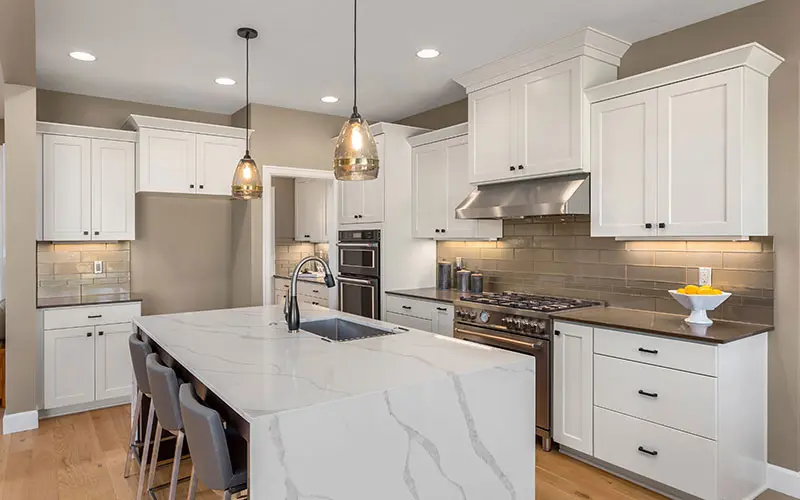
Clients selecting countertops for a Del Mar kitchen almost always ask the same question first: which one holds up better this close to the ocean. It is the wrong question, and answering it honestly is more useful than answering it as asked.
Salt air is a genuine problem in coastal homes. It attacks appliance panels, hinges, fasteners, and exterior hardware, and we spec around it constantly. What it does not meaningfully do is degrade an interior countertop. Marble fails from acid. Quartz fails from heat and ultraviolet light. Neither failure mode has much to do with proximity to the water, which means the coastal variable that should actually drive your decision is something else entirely: how much of your kitchen lives outside, and how much sun lands on the counter through the glass.
What marble does over time
Marble is calcium carbonate, and understanding that single fact predicts almost everything about how it will behave in a working kitchen.
Etching is chemical damage, not a stain
Acids dissolve calcite. Lemon juice, vinegar, wine, tomato, and a number of common household cleaners will react with the surface and leave a dull spot where the polish used to be. Nothing has landed on the stone. Part of the stone is gone. That distinction matters because clients try to clean etches, and etches do not clean. They are repaired by re-polishing, which is a fabricator visit rather than a wipe.
Staining is a different problem with a different fix
Marble is porous, so oils and pigmented liquids penetrate rather than sitting on top. Impregnating sealers slow that absorption and buy you time to wipe a spill before it sets. Here is the part that gets misunderstood in almost every showroom conversation: a sealer does nothing whatsoever about etching. It reduces staining. Acid still reaches the calcite and still reacts with it. Clients who were told their marble was sealed frequently believe they were told it was protected, and those are not the same sentence.
Finish changes what you see
Etching is a change in gloss, so a polished surface displays every one of them and a honed surface hides most. Honed marble in a heavily used kitchen ages into an even patina rather than a field of spots. Clients who love the look of polished Calacatta and cook seriously are choosing two things that fight each other, and the honest move is to say so during selection rather than at the twelve-month mark.
Edges are the other wear point. Marble is soft relative to the alternatives, and mitered or waterfall details concentrate impact at the most vulnerable geometry in the slab. Chips at an island corner are common and repairable, but they are not preventable through care.
What quartz does over time
Engineered quartz is roughly ninety percent ground quartz bound in polymer resin. The mineral is durable. The resin is the variable, and every quartz limitation traces back to it.
Heat is the practical limit
Resin scorches and discolors well below the temperature a pan off a burner reaches. A trivet is not a preference on quartz, it is a requirement, and the damage is permanent when it happens. Marble tolerates heat considerably better, which is why it remains the default for dedicated baking surfaces.
Ultraviolet light degrades the binder
Standard quartz is manufactured for interior use. Sustained UV exposure breaks down the resin and shifts pigment, and lighter colors move toward yellow first. Both Caesarstone and Cambria exclude outdoor installation and UV damage from warranty coverage, which is a clearer statement of the limit than any marketing copy.
The nuance worth carrying into a Del Mar project is the difference between direct exposure and glazed exposure. Glass filters a meaningful share of UV, and the industry position is that indoor installations behind windows perform well. Reports of lighter colors shifting over five to ten years under hard afternoon sun through large west-facing glass do exist, and this is contested rather than settled. If your plan puts a light quartz island under an unshaded ocean-facing wall of glass, that uncertainty is worth pricing rather than dismissing. If any part of the counter runs outside under a covered patio, it is not uncertainty at all. Standard quartz is the wrong material and the warranty says so.
What quartz does exceptionally well is everything marble struggles with. It is non-porous, so it does not stain or require sealing, and kitchen acids do not etch it. For a family that cooks constantly and does not want to think about the counter, that is the entire argument.
Where salt air actually matters
Having taken salt out of the countertop question, it deserves its place in the rest of the room. Chloride exposure pits lower-grade stainless at fasteners, hinges, and cut edges, and it works on cabinet hardware, faucet finishes, and appliance trim well before it touches stone. In homes with sliders that stay open most of the year, the finishes in the direct path of that opening age visibly faster than the ones eight feet away.
For countertops specifically, the coastal variable is exposure rather than chemistry. A Del Mar kitchen that flows into a covered outdoor counter has a UV and weather problem to solve at the transition, and the material that works on one side of the slider is frequently wrong on the other. We have written separately about the materials we stopped recommending on the North County coast, and most of that list is hardware and finishes rather than stone.
The California variable most selection guides ignore
Anyone specifying engineered stone in California in 2026 should understand where the regulatory picture sits, because it affects availability, fabricator selection, and cost in ways a national countertop guide will not mention.
Cal/OSHA adopted an emergency temporary standard for respirable crystalline silica in December 2023, targeting countertop fabrication, and the Standards Board approved permanent amendments in December 2024 that took effect the following year. Dry fabrication is effectively out. Wet methods, respiratory protection, medical surveillance, and shop-level compliance obligations are in. In May 2026 the board went further and granted a petition to begin rulemaking that would prohibit fabrication and installation of artificial stone containing more than one percent crystalline silica, after the California Department of Public Health confirmed 562 silicosis cases and 31 deaths among workers in the trade, with a median age at death of 52.
Two practical consequences follow for a homeowner. Compliant fabrication costs more and takes longer than it did three years ago, and the pool of shops able to demonstrate compliance is smaller than the pool advertising quartz. Ask any fabricator bidding your job to show current silica compliance documentation. It is a reasonable question, it filters the field usefully, and a shop that cannot answer it is a schedule risk regardless of how it prices.
The longer-term picture is genuinely unsettled. A California prohibition on high-silica engineered stone is now in active rulemaking rather than speculation, and clients making a twenty-year material decision deserve to know that before they sign a selection sheet. This section reflects the position as of July 2026 and should be verified against current Cal/OSHA rulemaking before you rely on it.
Comparing the two against the way you actually cook
| Consideration | Marble | Engineered quartz |
|---|---|---|
| Acid exposure from cooking | Etches permanently; repaired by re-polishing | Unaffected |
| Staining from oils and pigments | Porous; sealing slows but does not prevent | Non-porous; no sealing required |
| Direct heat | Tolerates it well; standard for baking surfaces | Resin scorches and discolors permanently |
| Sustained UV, covered patio or unshaded glass | Stable, though polish dulls with weathering | Resin degrades; outdoor use voids warranty |
| Edge durability at islands and miters | Softer; chipping at corners is common | Harder and more chip-resistant |
| How it ages | Develops patina; honed finish carries it best | Holds original appearance or shows discrete damage |
| California supply and fabrication outlook | Unaffected by silica rulemaking | Compliance costs rising; prohibition in active rulemaking |
The row that decides most Del Mar projects is not durability. It is the fourth one, because indoor-outdoor kitchens are the norm here and the material has to survive both sides of the opening.
How we approach the selection
We start by mapping the counter by use rather than by room. A baking zone, a bar, and a working prep island are three different exposure profiles, and there is no rule requiring one material across all of them. Marble on a bar or baking surface where patina reads as character, quartz where the daily cooking happens, is a common and defensible split that most clients are never offered.
Anything under sustained direct sun or outside a covered opening comes off the quartz list entirely. Porcelain slab and UV-rated outdoor collections exist for exactly this condition, and specifying one of them is cheaper than replacing a discolored island in year six.
One warning on the material clients often raise as the compromise. Quartzite is frequently proposed as natural stone with quartz-like acid resistance, and a significant share of slabs sold under that name are dolomitic marble rather than true quartzite. The distinction is not visible. A simple acid test on an offcut settles it, and any fabricator worth using will perform one without being pushed. Buying the label instead of the material is how a client ends up with an etching problem they were specifically told they had avoided.
If you are working through these decisions on a project here, our Del Mar kitchen remodel work and our general approach to kitchen remodeling both begin the same way, by establishing how the room will actually be used before anyone walks a slab yard.