

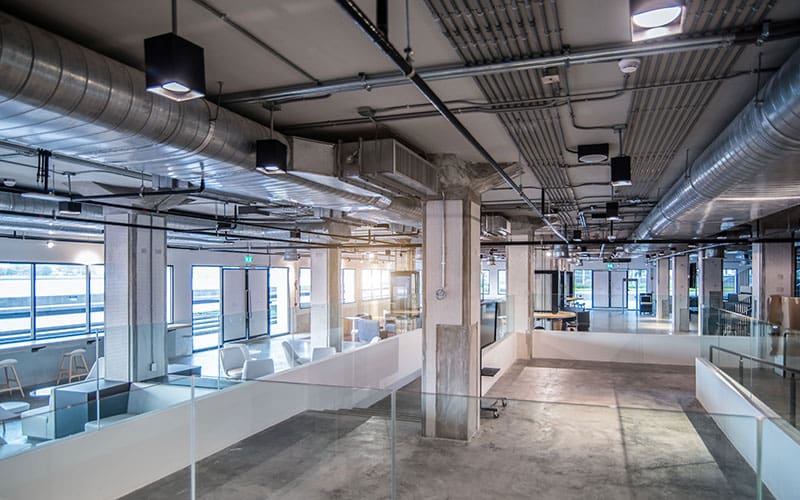
Commercial construction can mean three different things depending on who’s asking. A property owner wants to know what category their project falls into (office, retail, restaurant, etc.). An insurance company cares about building classification by fire resistance. A general contractor frames it by project type (ground-up new construction, tenant improvement, renovation, addition). All three frameworks are valid, and a comprehensive understanding requires recognizing all three.
This guide breaks down commercial construction across all three frameworks: by use and sector (the most common interpretation), by building classification under the California Building Code (the technical framework), and by project type (the practical framework that drives cost and process). Plus, California-specific considerations that affect coastal North County commercial projects.
Framework 1: Types by use and sector
This is the most common framing of “commercial construction types” and the one most property owners and tenants are actually asking about. Each sector has distinct space, code, and operational requirements that affect how the project is designed and built.
Office buildings
Office construction ranges from small single-tenant professional buildings (2,000–10,000 sq ft) to multi-story office complexes. Coastal North County office work is typically smaller-scale: professional service firms, medical office, professional buildings under 20,000 sq ft.
Key considerations: efficient floor plate design, daylighting for occupant productivity, robust HVAC zoning, structured cabling and AV infrastructure, restroom and break-area capacity sized to occupancy.
Retail
Retail construction includes single-tenant stores, multi-tenant retail centers, and shopping plazas. The North County market includes boutique retail in Del Mar, Encinitas, and Solana Beach plus mid-sized retail in Carlsbad and Encinitas.
Key considerations: storefront design and signage, customer-traffic-flow optimization, point-of-sale and inventory back-of-house spaces, loading and delivery access, ADA-compliant entries and circulation.
Restaurant and food service
Restaurants are among the most complex commercial projects. They have specialized infrastructure requirements that other sectors don’t: commercial kitchen design (ventilation hoods, grease traps, equipment power requirements, makeup air), front-of-house and back-of-house separation, dining capacity calculations driving plumbing fixture counts, walk-in refrigeration, dishwashing, bar service infrastructure, and county health department review for kitchen design.
Coastal North County has a substantial restaurant market across Del Mar, Encinitas, Carlsbad, and Solana Beach.
Medical and dental office
Medical and dental construction has its own infrastructure requirements: specialized power for medical equipment, plumbing for treatment rooms, lead shielding for radiology, HIPAA-compliant patient privacy in the floor plan, accessibility throughout, infection control protocols during construction in occupied buildings.
Medical office work has grown significantly in North County with the aging population and expanded suburban medical practices.
Fitness and wellness
Gym and studio construction is a growing commercial segment. Considerations include floor systems that handle heavy equipment (often raised floor with shock absorption), ventilation sized for heavy human occupancy, mirror walls and acoustic treatment, locker and shower facilities, and parking requirements scaled to peak class times.
Boutique fitness studios (yoga, pilates, spin, CrossFit) and mid-sized health clubs are common North County projects.
Mixed-use development
Mixed-use combines residential (typically upper floors) with commercial (street level). Common in Encinitas, Carlsbad, and Solana Beach as part of downtown infill development. Considerations include vertical separation between commercial and residential uses, separate utility services or sub-metering, fire separation between use categories, and dual entrance design.
Hospitality
Hotels, boutique inns, and short-term rental properties. Less common as ground-up new construction in coastal North County due to land constraints; more common as renovations and adaptive reuse. Considerations include guest room duplication efficiency, common area design, ADA accessibility, parking, and amenity spaces (pool, gym, breakfast area).
Professional services
Spas, salons, attorneys, accountants, real estate offices, financial advisors. These are smaller-footprint commercial projects (1,500–8,000 sq ft typically) with relatively standard infrastructure requirements but high finish-level expectations for client-facing spaces. Common North County work.
Light industrial and warehouse
Smaller-scale industrial buildings, flex spaces (combined office and warehouse), self-storage, and small manufacturing facilities. Considerations include clear-height for warehouse uses, loading dock or grade-level door capacity, floor loading capacity, dust and ventilation in production spaces. North County has limited industrial land but some specialty industrial projects exist.
Other commercial types
The above covers most coastal North County commercial work.
Other commercial types (large-scale industrial, manufacturing, distribution centers, big-box retail, large hotels, high-rise office) require specialized contractors with different scale capabilities and aren’t typical local projects.
Framework 2: Types by California Building Code construction classification
The California Building Code (CBC) classifies buildings into five construction types based on materials and fire resistance. This classification affects allowable height, area, occupancy, and required fire protection systems.
Property owners typically don’t drive this decision (the architect and engineer do), but understanding the framework helps in planning conversations.
| CBC Type | Description | Common in North County |
|---|---|---|
| Type I | Fire-resistive construction, non-combustible materials with high fire ratings | High-rise office, hospitals (limited in NC) |
| Type II | Non-combustible construction (steel, masonry) with lower fire ratings than Type I | Mid-rise office, larger retail, medical |
| Type III | “Ordinary” construction, non-combustible exterior walls (typically masonry) with combustible interior framing | Some retail, older commercial buildings |
| Type IV | Heavy timber construction, traditional mass timber | Specialty restaurant/hospitality |
| Type V | Wood-frame construction, both combustible and non-combustible variants permitted | Most small commercial in North County |
Type V is the most common commercial construction type in coastal North County because most projects fall within the height and area limits that allow wood-frame construction.
Type V-A (1-hour fire-rated) and Type V-B (non-fire-rated, smaller buildings) cover most retail, restaurant, office, and small commercial work in the area.
Construction type affects allowable building size. Type V-B caps at roughly 5,500 sq ft and one story for most commercial occupancies before requiring fire sprinklers or upgraded construction.
Type V-A allows roughly twice that with fire-rated assemblies. Larger projects step up to Type III or II for additional capacity.
Fire sprinkler systems significantly affect what’s allowable. Adding NFPA 13 fire sprinklers triples the allowable area in most construction types. Most commercial buildings over 5,000 sq ft in North County include sprinklers.
Framework 3: Types by project type
The most practical framing for property owners and tenants is by project type — the structural difference between what’s being built and what’s being modified. Three major project categories cover most commercial work.
Ground-up new construction
Building a new commercial structure from scratch on a vacant or cleared site. Requires full design, full permitting, full construction. Timelines typically 12–24 months from concept to occupancy depending on size and complexity. Highest cost per square foot because everything is new. Common in newly-developing commercial areas; less common in built-out coastal North County where infill and adaptive reuse dominate.
Cost range (North County): $200–$500+ per square foot for shell construction, plus tenant fit-out costs. Total commonly $300–$700+ per square foot for finished space ready for occupancy.
Timeline: 8–14 months for design and permitting, 8–14 months construction, depending on building size and complexity.
Tenant improvement (TI) / build-out
Modifying interior space within an existing commercial shell to accommodate a specific tenant’s use. This is the most common commercial project type in established markets like coastal North County. Common scenarios: new restaurant moving into a former retail space, professional office moving into a vanilla shell, medical practice fitting out raw space.
TI scope varies widely:
- Vanilla shell to finished space. Building out a previously unfinished shell with all interior infrastructure. Common when commercial buildings are constructed speculatively and finished per-tenant.
- Restaurant or retail change. Converting space from one commercial use to another. Often involves substantial mechanical, electrical, plumbing, and finish changes plus permit review for change of use.
- Refresh of existing tenant space. Updating finishes, lighting, and possibly minor layout changes for a renewing or rebranding tenant.
Cost range (North County): $50–$200 per square foot for typical office TI, $150–$400 per square foot for restaurant TI, $100–$300 per square foot for retail TI.
Timeline: 1–3 months design and permitting, 2–6 months construction.
Renovation, addition, or adaptive reuse
Substantially modifying an existing commercial building. Includes envelope expansions, structural modifications, conversion of building use (office to retail, retail to restaurant, etc.), historic preservation projects, and full gut-and-rebuild renovations of existing buildings.
Adaptive reuse is particularly common in coastal North County where older commercial inventory is being converted to higher-use purposes: retail to restaurant, restaurant to mixed-use, single-tenant office to multi-tenant. These projects involve significant code compliance upgrades because change-of-use triggers current code requirements throughout the building.
Cost range: Highly variable. Can range from $75 per square foot for simple refresh to $400+ per square foot for adaptive reuse with significant code upgrades.
Timeline: 2–4 months design and permitting, 4–10 months construction depending on scope.
How commercial construction differs from residential
A few important distinctions for property owners or tenants making the transition from residential experience to commercial projects:
- Code framework. Commercial projects are governed by the California Building Code (CBC) Chapter 3 occupancy classifications, while residential follows separate sections. Commercial code requirements are typically more stringent on fire protection, accessibility, and occupant safety.
- ADA compliance. Federal Americans with Disabilities Act requirements apply to commercial buildings and are heavily enforced in California. New construction and significant renovations must meet ADA accessibility standards throughout. ADA compliance often drives layout decisions, restroom design, parking provisions, and accessible route requirements.
- Title 24 commercial energy code. California’s Title 24 has separate, more rigorous provisions for commercial buildings than for residential. Commercial Title 24 affects lighting design, HVAC efficiency, building envelope, controls, and commissioning. HERS-equivalent commissioning is required.
- Fire department review. Most commercial projects require separate fire department plan review beyond the building department review. Fire department review covers life safety, sprinkler systems, alarm systems, egress, hazardous materials, and emergency access.
- Mechanical, electrical, and plumbing complexity. Commercial MEP is significantly more complex than residential. Larger HVAC systems with zoning controls, three-phase electrical service for many uses, commercial-rated plumbing fixtures, complex life safety systems.
- Permit and design fee scale. Commercial permits and design fees are higher than equivalent residential per-square-foot work. Plan check duration is typically longer (8–16 weeks for new commercial vs. 4–8 weeks for residential).
- Contract structures. Commercial construction more commonly uses cost-plus, GMP, and construction-manager-at-risk delivery methods than residential, which is more often fixed-price.
Coastal North County commercial considerations
Several factors specific to coastal North County affect commercial construction beyond general California commercial requirements.
Coastal Development Permit (CDP) review. Commercial projects in the coastal zone (parts of Del Mar, Encinitas, Carlsbad, Solana Beach, parts of Oceanside) require CDP review for any envelope changes or new construction. Review timelines run 60–120 days. Interior-only TI work typically doesn’t trigger CDP review but should be verified.
ADA Title III enforcement. California’s strict accessibility enforcement extends to commercial properties through CBC Chapter 11B (more rigorous than federal ADA). Restaurants and retail in particular face active ADA lawsuit risk if not compliant. Plan and build to full compliance.
Health department review for food service. San Diego County Department of Environmental Health reviews restaurant and food service projects. Review is separate from building permit and adds 2–6 weeks to permit timeline. Specific kitchen design requirements (3-compartment sinks, hand sinks at specific locations, dishwashing systems) must be incorporated from the design phase.
Fire department response. North County fire jurisdictions have specific requirements for fire alarm monitoring, sprinkler design, access for fire trucks, and emergency communications. Coordination with fire department early in design saves rework.
Title 24 commercial Climate Zone 7 requirements. Coastal North County is Climate Zone 7 for commercial Title 24 purposes. Specific requirements for cool roofs, glazing, HVAC efficiency, and lighting controls.
Historic district requirements. Some coastal North County downtowns (Encinitas, Carlsbad Village, Del Mar) have historic district overlays affecting facade modifications, signage, and exterior changes. Plan for design review board approval in these areas.
Parking requirements. California has been reducing minimum parking requirements (AB 2097 in 2022 eliminated minimums near transit), but local ordinances still apply in most cases. Verify parking requirements early.
Choosing the right commercial contractor
The right commercial contractor depends heavily on project type and scale.
For small TI work (under 5,000 sq ft): Small specialized commercial GCs or design-build firms with commercial experience. Often the same contractors who handle high-end residential remodel work also handle small commercial TI in coastal North County.
For mid-sized projects ($500K–$5M): Mid-sized commercial GCs with portfolio depth across multiple commercial sectors. Specialized experience in your specific use type (restaurant, medical, office) matters more than general commercial experience.
For ground-up new construction: Established commercial GCs with new-construction track records, strong subcontractor relationships, and capacity to handle the larger budgets and timelines involved.
For specialized uses (medical, restaurant, hospitality): Contractors with specific experience in your use type. Restaurant build-outs in particular benefit from contractors who’ve done several recent restaurants and understand the unique infrastructure and code requirements.
For practical guidance on hiring a contractor, see our questions to ask a general contractor piece and our what does a general contractor do guide.
Frequently asked questions
What are the main types of commercial construction?
By use: office, retail, restaurant, medical, hospitality, fitness, mixed-use, light industrial, and professional services. By California Building Code classification: Types I through V based on materials and fire resistance.
By project type: ground-up new construction, tenant improvement, and renovation/adaptive reuse. Each framework answers a different question and all three are valid ways to categorize commercial construction.
What’s the difference between commercial and residential construction?
Commercial construction follows the California Building Code commercial sections rather than residential. ADA accessibility applies. Title 24 commercial energy requirements are more rigorous.
Fire department review is typically required. Construction is typically larger scale and more complex with significantly different MEP requirements. Cost per square foot is generally higher than residential.
What’s a tenant improvement?
A tenant improvement (TI) is modification of interior space within an existing commercial shell to accommodate a specific tenant’s use. TI is the most common commercial project type in established markets. Cost ranges from $50 per square foot for simple office build-out to $400+ per square foot for full restaurant build-out.
How long does commercial construction take?
Ground-up new construction typically 16–28 months from concept to occupancy. Tenant improvement typically 3–9 months. Renovation/adaptive reuse typically 6–14 months. California-specific factors (CDP review for coastal zone, health department review for restaurants, fire department review, longer commercial plan check) can extend any of these.
What does commercial construction cost in coastal North County?
Highly variable by project type. Ground-up shell construction: $200–$500+ per square foot. Office TI: $50–$200 per square foot. Restaurant TI: $150–$400+ per square foot. Retail TI: $100–$300 per square foot. Full adaptive reuse: $200–$500+ per square foot. Coastal North County runs 15–30 percent above national commercial cost averages.
Do commercial projects need different permits than residential?
Yes. Commercial projects typically require: building permit, plumbing permit, mechanical permit, electrical permit, fire sprinkler permit (if applicable), fire alarm permit (if applicable), health department permit (for food service), and signage permit (for retail/restaurant). Plan check durations are typically longer than residential.
What’s CBC Type V construction?
California Building Code Type V is wood-frame construction. Type V-A is 1-hour fire-rated assembly construction; Type V-B is non-fire-rated. Type V is the most common commercial construction type in coastal North County because most local commercial projects fall within the height and area limits that allow wood-frame construction.
What does ADA Title III require for commercial?
ADA Title III requires public accommodation commercial buildings to be accessible to people with disabilities. California’s CBC Chapter 11B implements this with more rigorous standards than federal minimum.
Requirements include accessible parking, accessible routes, accessible restrooms, accessible service counters, and accessible communication features. New construction and significant renovations must meet current standards throughout.
Can I convert a retail space to a restaurant?
Yes, with appropriate permits. The change of use triggers current code requirements throughout the space, plus health department review, fire department review, and possibly utility upgrades. Change-of-use projects typically cost more than equivalent fresh build-outs because of the upgrades required. Plan for 6–9 months timeline from concept to occupancy.