

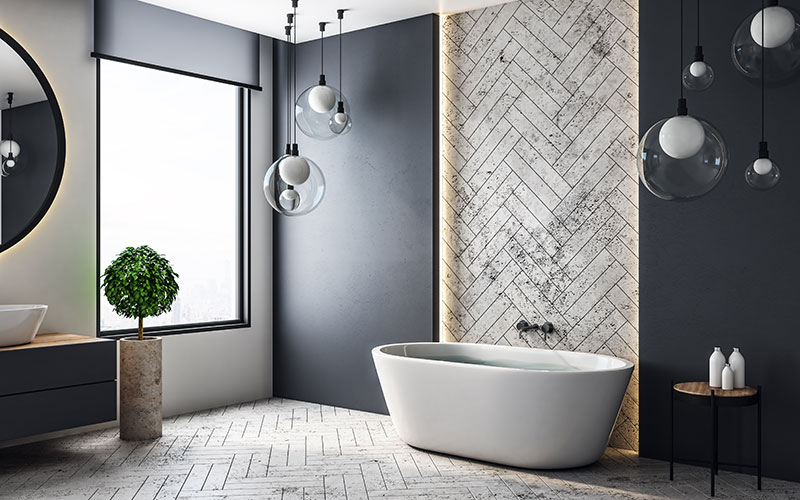
A bathroom isn’t a generic room. A primary bath, a guest bath, and a powder room each serve different functions and warrant different decisions. The same idea that works in a primary suite can fail in a powder room, and the materials that hold up in a low-traffic guest bath fall apart in a daily-use primary.
This guide groups ideas by bath type, then layers in style direction and the coastal North County constraints that change the spec at the cabinet and fixture level. For broader planning context, see our home renovation checklist.
Bath types compared
| Feature | Primary | Guest | Powder |
|---|---|---|---|
| Typical square footage | 80–150+ | 40–80 | 20–40 |
| Shower | Required | Usually | No |
| Tub | Optional or luxury | Often combo | No |
| Double vanity | Common in remodels | Rare | No |
| Storage | High demand | Moderate | Minimal |
| Use frequency | Daily, multi-person | Weekly | Occasional |
| Ventilation requirement | High | High | Moderate |
| Where to spend | Shower experience, vanity | Durability over taste | One bold statement |
The decisions below are calibrated to each row of this table. Skipping the bath-type alignment is the most common reason bathroom remodels finish looking expensive but functioning poorly.
Primary bathroom ideas
The primary bath earns the highest dollar per square foot in most remodels because it carries daily use, two-person mornings, and the experience the household actually lives with. Layout is the first decision because it constrains everything else.
Curbless walk-in shower.
A curbless shower with a linear drain reads more open than a tub-shower combo and lets the floor tile run continuously through the shower zone. Aim for 36 by 60 inches minimum, 42 by 72 if space allows.
Works when your subfloor can be properly waterproofed and the drain can pitch out. Skip in older slab homes where modifying drain depth requires concrete cutting.
Separate soaking tub.
A freestanding soaking tub anchors the room visually. Air-bath and acrylic models start around $1,500 installed; cast iron and copper run multiples of that. Works when you take more than two baths a year. Skip if the tub will become a planter, which it will if it’s there for resale appeal alone.
Double vanity, sized correctly.
A 60-inch vanity reads tight for two users. Aim for 72 inches minimum if you want functional double-sink use. Single 48- to 60-inch vanities with one sink and more counter space often beat a cramped double. Floating vanities make small primary baths feel bigger but reduce storage by 20 to 30 percent.
Lighting at the mirror, not just over it.
A single overhead fixture at the vanity casts shadows under the eyes and chin. Add wall sconces flanking the mirror at face height (66 to 72 inches above the floor) for actual usable light. A separate ambient layer (recessed cans on a dimmer) handles night use and creates the spa feel that single-source lighting can’t.
Materials calibrated to use.
Marble countertops in the primary are a real risk because cosmetics and hair products etch them. Quartz reads similar at half the maintenance.
For floors, large-format porcelain (24 by 24 or 24 by 48 inches) reads more current than 12 by 12 and has fewer grout lines to maintain. Heated floors are the single best small upgrade in a primary if your budget allows.
What to skip.
All-glass shower walls without a half-wall to break the glass plane (every fingerprint shows). Trough sinks (water pools and looks unclean fast). Open shelving in primary baths (humidity destroys what’s stored). Black slate floors (every speck of toothpaste shows).
Guest bathroom ideas
Guest baths are where personal taste should yield to durability and broad appeal. The bath gets used by visitors, kids, and occasional household members who don’t know your habits. The features that work are the ones that hold up to varied use without showing wear.
- Tub-shower combo. A 60-inch tub-shower combo serves a guest bath better than a shower-only setup unless you have a separate kids’ bath in the home. It accommodates kids, multi-generational visitors, and resale appeal. A built-in alcove tub with subway tile surround is durable, classic, and never reads dated.
- Single vanity, deeper counter. Single 36- to 42-inch vanities with deeper counters provide more usable space than wider shallow counters. Look for 22-inch deep counters where 18 to 20 is standard. Storage behind doors costs less than drawers and works fine for guest-bath use where access frequency is lower.
- Tile choices that hide use. Light grout shows every spot. Mid-tone gray and beige grouts hide use better. Larger floor tile (12 by 24 or 18 by 36) means fewer grout lines to maintain. Wall tile in a guest bath should be glazed ceramic or porcelain rather than natural stone, since stone requires sealing and guests won’t know to avoid certain products.
- Lighting that’s bright and flattering. Guests don’t know your dimmer settings. Default to enough brightness for makeup and shaving without needing to fiddle. Sconces or vertical bath bars beside the mirror outperform a single overhead bar.
- Ventilation that actually works. A 50 CFM exhaust fan is code minimum and isn’t enough. Specify 80 to 110 CFM with a humidity-sensing switch, especially in coastal climates. Mold in guest baths is among the most common callbacks Skyhorse sees in projects we didn’t build.
- What to skip. Wall-mounted toilets in guest baths (repair access requires cutting drywall). Glass shelving in the shower (visitors don’t move shampoo bottles when they leave). Heavy patterned wallpaper that ages fast. Statement floors in light marble (etching from one guest’s hairspray is permanent).
Powder room ideas
A powder room has the smallest footprint of any bathroom but the highest design impact per square foot. It serves no shower, no tub, no daily routine, just guest use during entertaining. That makes it the right place for design choices you wouldn’t make in a daily-use bath.
- Be bold with materials. A powder room is the right room for the dramatic wallpaper, the colored tile, the saturated paint, the ornate vanity, the unusual mirror. Because there’s no shower, humidity isn’t a concern, and you don’t live with the choice every morning. Pick the option that makes guests stop and look.
- Statement vanities and sinks. Console-style vanities with exposed metal frames, vessel sinks on stone slabs, antique cabinets converted to vanities, wall-mounted sinks with a single column, marble pedestal sinks. A powder room can hold a vanity choice that would feel performative in a daily-use bath.
- Mirrors that go bigger. Powder rooms feel cramped fast. A mirror that fills most of the wall expands the space visually. Round, oval, and arch-top mirrors all work better than rectangular in tight footprints.
- Lighting as jewelry. A single small pendant or pair of sconces functions as the room’s design feature. Decorative is fine here in a way it isn’t in a primary, because the lighting needs are minimal.
- Plumbing constraints in tight footprints. Most powder rooms tuck into closets, under stairs, or in corners with no exterior wall. That means no exterior venting for an exhaust fan and limited drain routing. A recirculating exhaust with charcoal filter handles the fan requirement. Drain placement is fixed by the existing waste line, which is why moving a powder room toilet is rarely worth the cost.
- What to skip. A second sink (no powder room is large enough for two). Soaking tubs (you don’t bathe here). Heavy doors that swing into the room (every inch matters). Floor tile too small for the footprint (it makes a small room read busier).
Style direction across all three bath types
Style cuts across bath type. The four directions below cover the bulk of North County remodels.
| Style | Defining elements | Typical materials | Hardware | Best for |
|---|---|---|---|---|
| Modern / contemporary | Clean lines, minimal ornament, frameless glass | Large-format porcelain, quartz, glass | Matte black, brushed nickel | Primary, sometimes powder |
| Traditional | Detailed millwork, paneled vanities, classic tile | Marble or quartz, subway tile, hex floor | Polished brass, polished nickel | Primary, guest |
| Transitional | Mix of clean and detailed, neutral palette | Quartz, large tile, mixed metals | Brushed nickel, matte black, mixed | Any |
| Coastal | Light tones, natural texture, water references | Light stone or quartz, weathered wood, glass | Brushed nickel, polished chrome, brass | Any, especially in coastal homes |
Transitional is the safest direction for guest baths and any bath where resale matters. Coastal works in North County contextually but reads dated faster outside coastal homes. Traditional and modern both have strong points of view that should match the rest of the house.
Coastal North County and condo realities
The constraints below apply on top of any of the ideas above when you’re remodeling in a coastal or condo property.
Fixture finishes for salt air. Polished chrome corrodes fastest near the coast. Brushed nickel, powder-coated black, and solid brass (which develops patina rather than failing) hold up better. Verify warranty coverage for coastal installation before specifying any fixture.
Mirror silvering. Cheap mirrors in coastal humidity develop black edge corrosion within a few years. Specify silvered glass with proper edge sealing or accept that the mirror will need replacement on a five-year cycle.
Exhaust fan capacity. Code minimum (50 CFM) doesn’t move enough air in coastal humidity. Specify 80 to 110 CFM minimum, 110 to 150 for primary baths with steam showers. Humidity-sensing switches that run the fan until humidity drops to a target are worth the modest upcharge.
Cabinet box construction. Coastal humidity swells unsealed MDF cabinet boxes. Plywood boxes with moisture-resistant finishes handle humidity without warping. The upcharge is modest and avoids the typical five- to seven-year replacement cycle.
Condo plumbing stack constraints. Like kitchens, condo bathrooms run through shared vertical plumbing stacks. Moving a toilet, shower drain, or sink more than a few feet from existing rough-ins may not be feasible without a new plumbing chase, which the HOA may not approve. For condo-specific guidance, see remodeling your condo.
Sound transmission and flooring. Most condo associations require sound underlayment under hard flooring. Bath floors are often hardest to spec correctly because tile, mortar, and underlayment all interact with the rated assembly. Verify the IIC rating required and select assemblies that meet it.
HOA review and approvals. Condos and Covenant communities require approval for bathroom work touching plumbing, electrical, or shared walls. Approval timelines run 30 to 90 days. Build that into the schedule before signing a contractor agreement.
Mistakes worth avoiding
A few patterns generate most of the regret in bathroom remodels.
- Heavily patterned tile schemes. Geometric mosaics, hex patterns with bold accents, and Moroccan-style tile age faster than any other surface in a bath. The pattern that reads “current” today often reads “dated 2024” in five years. If you want pattern, put it in a powder room where you can change it more affordably than in a primary.
- Lighting that flatters in showrooms but fails at the mirror. Cool-temperature LEDs (4000K and above) are unflattering at the vanity. Specify 2700K to 3000K at the mirror for skin tones that look like skin. Pair with a separate brighter ambient layer for cleaning and daytime use.
- Skimping on exhaust capacity. A 50 CFM fan with a 4-inch duct is functionally the same as no fan at all once humidity loads. Specify enough CFM and proper duct sizing or expect mold callbacks within a year.
- Trough sinks. They photograph dramatic and live miserably. Water pools, soap film accumulates, the basin is awkward to clean. Two separate sinks in a 72-inch vanity outperform a trough every time.
- Wall-mounted toilets. They look clean and modern. They also require cutting drywall to access the carrier when something fails. Specify only when you’re committed to the maintenance reality.
- Cheap fixtures with premium finishes. A $200 chrome faucet with a bright finish wears off in 18 months. The cost difference between cheap and good faucets is usually $100 to $300, which is recovered in the avoided replacement cycle.
Frequently asked questions
What’s the best layout for a small bathroom?
For a small primary, lose the tub in favor of a larger curbless shower if you don’t bathe regularly. For a guest bath, a 60-inch tub-shower combo with a single vanity opposite reads bigger than the same room with a separate shower and tub. For a powder, a wall-mounted sink and corner-set toilet recover floor space.
How do I choose a style direction for my bathroom?
Start with the rest of the house. A bathroom that doesn’t share material and finish references with the kitchen and living spaces reads disconnected.
Transition is the safest direction when you’re not sure. Modern, traditional, and coastal all have strong points of view that should match the rest of the home.
Should I put a tub in my primary bath?
If you take baths more than once a month, yes. If not, the floor space and budget are better spent on a larger curbless shower with a bench. Tubs in primary baths with one or two adults often become planters within a year of move-in.
How do I plan around salt air in a coastal bathroom?
Specify brushed nickel, powder-coated, or solid brass fixtures rather than polished chrome. Use plywood cabinet boxes rather than MDF. Verify mirror silvering quality. Specify 80 to 110 CFM exhaust fans minimum. Confirm warranty coverage for coastal installation on every fixture.
What’s the most common bathroom remodel regret?
Lighting that flatters in the showroom but fails at the mirror, and exhaust fans undersized for the bathing patterns the house actually has. Both are easy to specify correctly upfront and expensive to remediate later.
How long does a bathroom remodel take?
A cosmetic refresh runs 2 to 4 weeks. A mid-range remodel with new tile, fixtures, and vanity runs 4 to 8 weeks. A full gut with layout changes runs 8 to 14 weeks. Add 2 to 4 weeks for permitting if scope triggers it. Material lead times on custom vanities and specialty tile can extend any of these.
Learn more: Cost to Add a Bathroom